

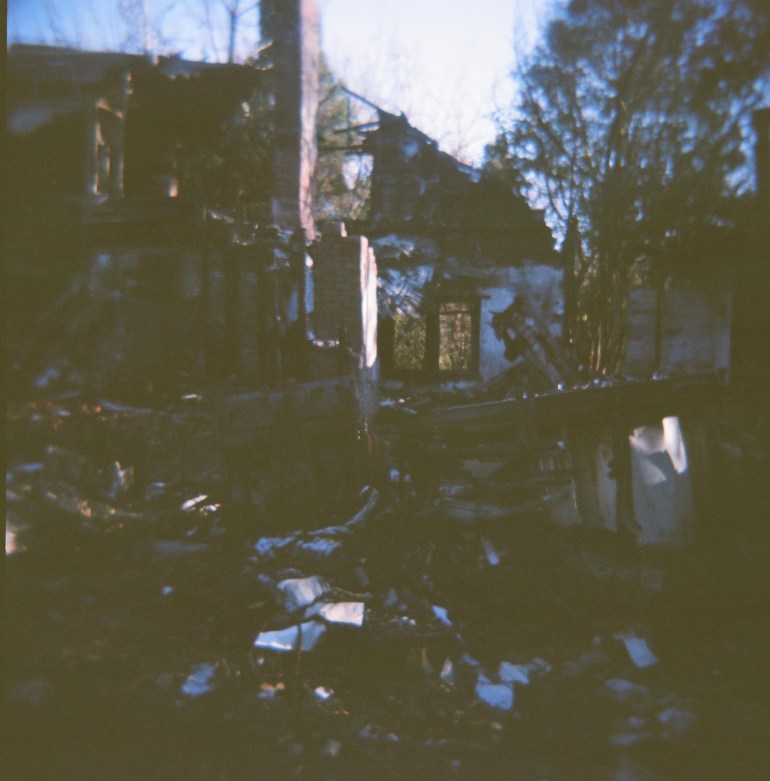
In 2009, when I heard that Cormac McCarthy’s childhood home in South Knoxville burned down, I went looking for it. I hadn’t yet become haunted by No County for Old Men, which forever ruined me to psychological thrillers and places (like the wreckage of a burned home) that might have evoked them.
Back then, my husband and I still lived in the national park, and often if he had to work on a weekend I would take myself on little adventures to explore spots around Blount County and South Knoxville with my Holga camera. This was perhaps a vestige of a corny avant-garde wannabe high school self, but also in hindsight a wholesome way to spend time before I had many friends in town. It was certainly well before Instagram filters cheapened the effort of capturing vintage-looking photography.
What I remember standing there at the site of his burned-down childhood home—which preservationists had warned was a threatened historical site—was that I felt I was intruding on someone’s life, even though I didn’t know the details. I was sorry because I knew McCarthy was a private person. I took some pictures and fled as if one of his characters might arise from the ashes and hunt me down.
These many years later, beyond the stories and characters McCarthy created, I am curious about the life he lived here. When he left Knoxville for his ancestral home in Ireland, he ended up meeting his wife Anne in England and traveling around Europe. Some articles glance over the details, saying that when he returned to East Tennessee, they settled in Knoxville. However, I recently read that it was actually Blount County.
First, they lived in Rockford, renting a house on a pig farm. Later they moved near Louisville to live in a barn, and he embarked on a serious restoration. Not only did he gather all the stones to build a room, but he also cut and kiln-dried the wood. Perhaps the most notable feature was a new fireplace with salvaged bricks from James Agee’s childhood home. I imagine that McCarthy must have had the foresight to take those bricks before the Agee home place was demolished to make way for apartments during Knoxville’s “urban renewal.”
The eulogies and commentaries I’ve read have focused on McCarthy’s influence on Knoxville (and Knoxville’s influence on him), his incredible body of work, and the interesting arc of his career, which quite frankly in this modern world of book publishing that pressures writers for early success might not even be possible today. But now I’m fixated too on what he must have felt about this particular place—my adoptive home in Blount County—and the history and connection to place it seems he was trying to preserve.
I took only pics, no bricks. But I think there’s something more I can take from his legacy than his stories and lyrical prose that reveals a deep love for the land. Maybe it is just this simple: Love of place is far from fiction; it’s alive, whether immortalized in art or simply experienced. In my community, that’s some of the surest ground I’ve ever been able to stand on in good times and in hard times.
RIP Cormac McCarthy.
 Élan Young